In the fictional couch: Beef’s Lindsay and Josh in couples therapy
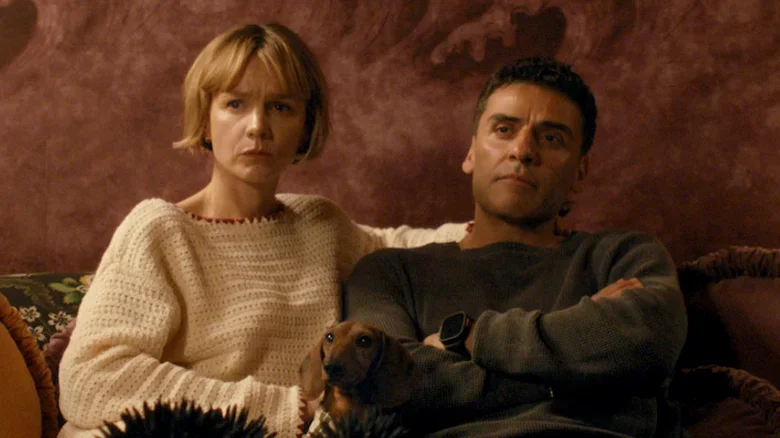
The philosopher Slavoj Žižek argues that a movie’s world-ending catastrophe is often not what the story is really about. Instead, the catastrophe serves a very specific psychological purpose: it is summoned to fix a deeply broken human relationship. When a bond between two people becomes so emotionally deadlocked and stagnant that it feels impossible to repair through normal, everyday effort, the catastrophe stages a narrative in which it enables its heroes to do the unthinkable, to try different ways of relating.
Žižek uses Steven Spielberg’s War of the Worlds as an example. On the surface, it’s an end of the world spectacle of alien tripods vaporising humanity. But behind the spectacle of the catastrophic invasion, it’s really about a divorced, neglectful father (Tom Cruise) who has lost the respect of his children. The alien invasion is summoned to do the impossible work of fixing this family, that in the real world (which is not ending) the dynamics have become so stagnant that its members don’t know how else to connect. By turning the complex, emotional challenge of parenting into a simple, physical race for survival, the film lets the dad finally earn his kids’ love. (In the end, this resembles more a male phantasy of paternal love than anything else, but it makes the point all the same.)
Of course, this is a pure fantasy resolution. In real life, we don’t have Hollywood writers to script alien invasions to shock our relationships back to life. Instead, we often sleepwalk through our lives and our relationships, feeling stuck in harmful, resentful, or stagnant dynamics, feeling meh and disconnected without ever fully taking in where we are, who we are, or who we are to each other. Sometimes, real-life versions of the “end of the world” do crash into us, like a sudden loss, infidelity, or ill health, forcing us to wake up and confront our place in the world and in our relationships.
But we don’t have to wait for a disaster to save us from our stagnant and frustrating relationships. There is another, far more intentional way to fully feel ourselves, be present, and wake up to our relationships: couples therapy. In many ways, couples therapy can act as its own controlled “end of the world.” It is a space designed to shake us out of our sleepwalking state, forcing us to face ourselves and our partners, whatever that ultimately means for the future of the relationship.
As a couples therapist, I often watch TV shows and films, or read books through this exact lens. I find myself wondering: did these two characters really need a massive, screen-shattering catastrophe and go completely off the rails and figure out whether to choose or not choose each other? Following that question, this blog series is my exploration of what couples therapy would look like for some of on-screen or on-page couples, and where they might have ended up, together or apart, without needing their world to burn first.
The first couples on the couch, then, will be the couples of the second season of Beef. A quick spoiler warning before we start: this piece discusses the plot of Beef’s second season in full, including its ending, so if you haven’t watched it yet and want to go in unspoiled, this is the moment to close the tab and come back afterwards.
Summary
Beef’s second season follows the fallout after Josh and Lindsay, general manager and wife at an exclusive country club, are caught on video having a vicious argument at the club’s charity gala by two of their staff, Austin and Ashley, who use the footage to blackmail them. Josh and Lindsay have been married for years, running a stalled dream of opening a B&B alongside the club, and the argument that opens the season turns out to be one round in a much longer, ongoing fight rather than a single breaking point. After a chaotic spiral involving corporate corruption, embezzlement, and a late-season attempt on Josh’s life, the season ends with Josh taking the fall. He falsely confesses to the embezzlement to shield Lindsay, Austin, and Ashley from prosecution, ultimately landing in prison.
Couples therapy with Josh and Lindsay
In a first session with a couple, I always ask for their history before I want to know their complaint. How did they meet? What was going on for each of them at that point in their lives? What attracted them to each other? This gives me a sense about why they (often unconsciously) chose each other. This tends to reveal a great deal about the level and nature of a couple’s dysfunction, because people very often choose partners unconsciously, drawn to someone who will enable their own defence mechanisms, and who is operating at a similar level of differentiation to their own. We don’t choose partners at random. We sometimes choose people who leave our defences undisturbed, exactly where we think we need them to stay.
If Josh and Lindsay were narrating their relationship history, two things would stand out for me, points where I would ask them to pause, and use that part of their story to reveal their dynamic. The first is how they respond to Burberry’s death. Rather than grieve him honestly after he dies, which would mean sitting with real loss and real vulnerability together, they replace him with a near-identical dog and make an unspoken agreement not to look too closely at the differences, suppressing, both internally and between each other, the unease that surfaces whenever the new dog does something that gives him away. It would have been so much simpler, and so much more human, to grieve openly. Instead they choose an elaborate substitution, a jointly maintained fiction, because perhaps facing the actual loss together was never something either of them knew how to do.
The second part of their narrative where I would pause is another demonstration of that same avoidance that shapes the much bigger fiction they’re both living inside. That is their future goal of building a luxurious B&B they will open together one day, a future that stays permanently just out of reach and permanently unexamined, while the actual present they’re living in is almost the exact opposite of that fantasy: high conflict, close to violent, saturated in resentment, anger and disconnection. It’s much easier to keep imagining the life you’ll have than to look honestly at the life you’re actually in. Inside the gap between the lived and the imaginary life, each of them has found a different place to stand. Josh is stuck in his manager role. Lindsay is stuck in her resentment. She blames him for everything unrealised in her own life, financially, professionally, the child she doesn’t have, treating each of these as things done to her rather than as choices, or absences of choice, she has also had a hand in.
Josh, meanwhile, tries to fix things almost like a panicked headless chicken. If he were my client, I would express my observation that I don’t think the manager role is only a professional one. I think it’s the role he embodies in his relationship with Lindsay, and potentially with others, and with himself.
The manager’s role, is the role of the person who takes on responsibility for everyone else’s crises, moods and stability, managing a household or a relationship by absorbing its problems rather than sharing them out honestly between the people in it. It’s very often assigned early in life: the manager becomes indispensable, but rarely intimate. That’s exactly the shape of what Josh does at the club, and what he brings home with him. He handles crises by hiding them from everyone and trying to fix them quietly behind the scenes, and the more he does this, the more he messes things up, each hidden fix creating a new problem that then also has to be hidden.
He is, in a sense, a good bad manager. He’s genuinely excellent at managing the club, the good part is where he embodies the people-pleaser role about as perfectly as it can be embodied, and the bad part is internal, where he grows steadily more resentful and unhappy with the people-pleasing role, perhaps because the whole performance only exists to keep disaster under control, never to let him actually live. The good bad manager is an inauthentic stance in life. Inauthentic, because the way he lives and relates to others doesn’t resonate with how he actually feels internally. In existential psychotherapy, this kind of inauthenticity leads to existential anxiety. That superficial good versus underneath bad sense of being characterises both him and their relationship.
If Josh and Lindsay were in my consulting room, after getting a sense of their individual and shared stories and understanding their dynamic, the first question I would ask myself is the one I ask myself with every high conflict, dysfunctional couple: what is the function of the dysfunction. The secrecy, the resentment, the anger, the denial, all of it is serving a purpose. It is protecting each of them, individually, and protecting the two of them as a couple, from something. Finding out what that something is would be the actual work of the therapy, disaster or no disaster.
The function of the dysfunction
Existential therapy is about presenting people with different ways of being, and gently inviting them to face them. What would happen if they chose not to respond to the other’s anger with anger? What would happen if they never replaced Burberry, and stayed with their grief instead?
These are the questions I ask my clients, giving them space and gentle questioning to get to the real answer. I would imagine that if I asked either of them either of these questions, they would respond with helplessness and project responsibility onto the other. Josh might say that he went along with Burberry’s replacement to make Lindsay happy, and Lindsay might say that she responds with anger because Josh brings the worst out of her.
Upon gentle pushing, I would imagine Josh responding that the world where he doesn’t deceive himself despite Lindsay’s grief, is one he can’t handle. He might say something like “I can’t handle that,” “It’s impossible,” or “That would be too hard.” My next question would be to ask him to explicitly define “it” or “that,” or whatever other pronoun he’s using to stand in for the thing that prevents him from fully acknowledging reality. I would expect Josh to need some encouragement before he could say explicitly that “this” or “that” translates directly to “Lindsay’s emotions.” This is a very common place for couples to arrive at. But again, the answer isn’t deep enough to fully reveal his emotional struggle. I would say something like, “So what if Lindsay has emotions? It’s normal that she’d be in pain, she loved Burberry. She may even want to stay in denial about it. That’s her emotional reaction to have.” I was working with a couple recently who were stuck in the same deadlock, and I can imagine Josh saying what one of those partners said: “Yes, but I don’t know what to do with her pain.” This certainly is a more honest response.
Clients often share that they feel immobilised, anxious, useless, or angry in the face of their partner’s emotions. What’s really happening is that it isn’t their partner’s emotions they don’t know how to handle, it’s the emotions their partner’s emotions bring up in them. And how they experience those emotions often has a great deal to do with how they encountered similar emotional experiences in childhood. Josh appears to be someone who was a manager as a child, which suggests the emotional landscape he grew up in might not have been safe enough, perhaps there was a lot of conflict, or he was given the role of resolving conflict between others (parentification), or of soothing other people’s emotions for them.
So when Josh goes along with the fake Burberry, he is trying to manage his own emotions by managing and calming Lindsay. Guessing, again, at how this might have developed as a coping mechanism in childhood, perhaps he learned to act as the good, obedient, happy boy whenever his parents argued, or his mother was angry or sad, in order to manage their moods and feel safe again himself. He does the same thing with Lindsay now. He manages her feelings in order to protect himself from feeling his own. And this is low differentiation in practice. Differentiation is the capacity to stay emotionally connected to another person while still remaining a separate self, able to hold your own thoughts, feelings and reactions without either fusing with the other person’s or cutting yourself off from them entirely. Someone with low differentiation struggles to do this: their own sense of self gets swallowed by whatever the other person is feeling, so managing the other person’s emotions becomes a way of managing, or avoiding, their own.
Lindsay relates to him through resentment, and she is immobilised by it. She, too, chooses to mask the pain of Burberry’s passing by treating the new dog as him. This is its own act of denial, a refusal to let herself experience the pain and grief directly. She needs Josh to play along in order for her defence mechanism to function at all. And this is where the two of them are locked together.
If she were my client, going through her list of resentments one by one, I would probably ask her what would happen if she stopped being resentful. I would imagine she would initially say that it is impossible, that Josh has done so much to her over the years that resentment is only a normal reaction, but upon further encouragement she would likely say that she would either have to accept the reality of feeling unfulfilled and sad for the rest of her life, or leave. But these are real options, ones she would have to confront and take actual responsibility for choosing. Her resentment is precisely what stops her from making either of those choices (or any other choices that may be available to her). It lets her evade the responsibility of choosing at all, and Josh is unconsciously enabling that. This is where I would pause and slow down and let her take in and fully explore her response and what it means.
In couples therapy each partner of this couple would be encouraged and challenged to take responsibility for their own contribution to the dynamic, take ownership of their emotions and think of their stance in more creative ways, recognise and challenge their defences, and recognise and accept each other, to be able to reach a point where they can make an informed decision about whether to stay together or not. Couples with this level of conflict may eventually break up not because they make an informed decision but because their relationship breaks them up. They feel so stuck and their only way out is to run away from their dynamic. I believe that this is what happened when Lindsay asked Josh for a divorce. It did not come from an informed, examined place, but as a knee-jerk reaction to the suffering they both experienced. The shattering events had released her; they had made the choice for her. In cases where the conflict is more low level or not explicit, couples may become numb to it and not even realise that it is not normal.
The function of their dysfunction, then, is how their defence mechanisms complement each other and create this state of tense equilibrium. Because they do not know how else to deal with their own emotions or each other’s, this conflict is the only way they can stay together. Without this conflict, they may be at loss at how they can be together. They either stay together in conflict, or they break up entirely. If they were in couples therapy, they would have to take responsibility for their own responses to the conflict, and try to bracket their anger and resentment and fully see their partner, not as an enemy, but as another human being in pain. Based on the ending of the series, I am hopeful that these two could stay together, that they could see beyond their resentment and take the leap of faith and become more emotionally mature individuals, able to relate to each other in more fulfilling ways.
A few months ago, a couple in the room had a very strong argument with each other. I let them have it for a bit and then I stopped them. I asked them, “When you argue like that, how old do you feel?” The female partner said, very angrily, “He behaves like he is 13 years old.” Then I asked her, “And when you argue with your 13-year-old partner, how old do you feel?” She said, with a lot of anger in her voice again, “He makes me feel like I am 13 too.” I then asked her, “When he argues like a 13-year-old, how would it be for you to respond to him as an adult?” Something resonated for both of them then, and whenever they argued they both tried to take responsibility for their responses, and not allow the other to drag them down into their immature arguing. I explored with them what was going on for them when they were 13-year-olds, and what the conflict really signifies for them, but for economy of space, I will not further analyse that.
When a couples therapist witnesses a couple arguing like that in therapy, they can offer the guidance to help them view their conflict from a different lens, not with shame and guilt, but with curiosity and compassion. However, Josh and Lindsay are not witnessed by a therapist arguing violently, but by a young couple who, in many ways, are their mirror images. This symbolic gaze signifies a moment of truth for them, which means that they cannot hide from the dysfunction of their relationship and pretend it doesn’t happen the way they used to. If we imagine Austin and Ashley as an internal symbolic gaze, a moment of recognition, then that recognition is marked by shame, ridicule and panic, as we see the events it sets afterwards. Interestingly, we see that they are dysfunctional in every possible way, but work quite well when they have to work on protecting their defences, undermining their conflict, bringing the fake Burberry home, that is how they de-escalate, there is almost connection in these scenes. Being witnessed at their most vulnerable, angry and dysfunctional, and feeling fear, shame and anger as a result, they respond not with recognition, curiosity or a willingness to change, but as they always have: by starting a series of events to cover up their dysfunction.
There is an interesting scene later in the series where Josh takes a fast-acting psychedelic, bufo, and during the trip sees the faces of every woman he has ever slept with, ending on Lindsay. Her face morphs into his mother’s, who tells him he doesn’t have to try so hard, that she loves him regardless. They embrace, and when he looks at her again, he sees his own face looking back, and panics. Every woman collapsing into Lindsay, and Lindsay into his mother, suggests these have never really been separate people to him, so much as one figure he is endlessly trying to please and be reassured by. And seeing only himself when he looks again is the point of the scene: strip away every role he performs for someone else, and there is no separate self left underneath, only Josh, with nothing left to manage. What the scene actually reveals is that the person he isn’t relating to, underneath everything, is himself, perhaps that part of himself that feels threatened by other people’s emotions and desperately tries to polish them. The managing was never really about the club members, or his family, or even Lindsay. It’s the way he keeps his own internal world from collapsing, by never once being still enough with himself to find out what’s actually there. It’s this experience that softens him towards Lindsay afterwards, well before the far more dramatic clarity that comes later, in the finale, when his life is actually on the line.
It’s against this backdrop that the finale matters so much. Captured alongside Lindsay, Ashley and Austin, and having just survived an attempt on his life, Josh, having realised, the hard way, that it is himself, and his own emotions, he has been trying to manage all along, makes his first free choice: he chooses to falsely take responsibility for the entire scheme so the other three can walk free. This is not an attempt of reconciliation with his wife, they separate afterwards, permanently, but it is the first freely chosen act either of them makes across the whole season, arriving from a sudden, brutal clarity about what he actually values, produced by the direct confrontation with his own mortality. Mortality, in the oldest existential sense, cuts through years of denial and allows a person to act, finally, from conviction rather than habit.
That clarity seems to do something to him afterwards, too. Paradoxically, prison appears to deepen this freedom rather than end it. One kind of freedom is a freedom of options, of what a person can actually do, and by that measure Josh has never been less free. The other has nothing to do with circumstance, it’s the freedom in how a person relates to whatever situation they’re in, and it cannot be removed even under total constraint. Josh’s old life, all the money and apparent openness of choice, had in practice supplied him with endless room to avoid ever deciding who he actually was, since there was always another deflection available. Prison removes every one of those exits. And it isn’t the first time he’s arrived here. What happened on bufo was the same discovery, but reversible, he could come down, deliver his monologue, and go back to being the fixer the next morning, which is more or less what he does. Prison is that discovery with every exit finally removed. He did not become free despite losing his options. He became free because losing them meant he could no longer flee the place he had already seen once, and finally had to stay.
At the same time, Lindsay is in England, with a child, but she does not look happy again. When she reads the news of his release, she looks loving. All the love between them had been hiding behind the fighting and the resentment. Neither of them had ever allowed themselves to feel it, and neither had made it safe for the other to feel it either. I believe that despite the high level of conflict, if Josh and Lindsay entered couples therapy, they could save their relationship. They felt so stuck and lost that their separation was more a flight than walking out with intention. Couples therapy would offer them the space to reflect on and understand what their stuckness and conflict meant, challenge the deceptive way they have become accustomed to relating with themselves and with each other, and help them feel safe enough within themselves to relate with more integrity, responsibility and maturity towards one another.
The paradox is that Austin and Ashley did stay together, even though I believe couples therapy would have enabled them to break their codependent pattern and separate. But that is for the next post.